
Compute the exact expected payment for every invoice after mapped debit notes, then flag each short or missing payment automatically — so revenue leakage surfaces the day a settlement lands, not at month-end.
 Zepto
 Swiggy Instamart
 Amazon
 Flipkart
 Myntra
 DMart
 Metro
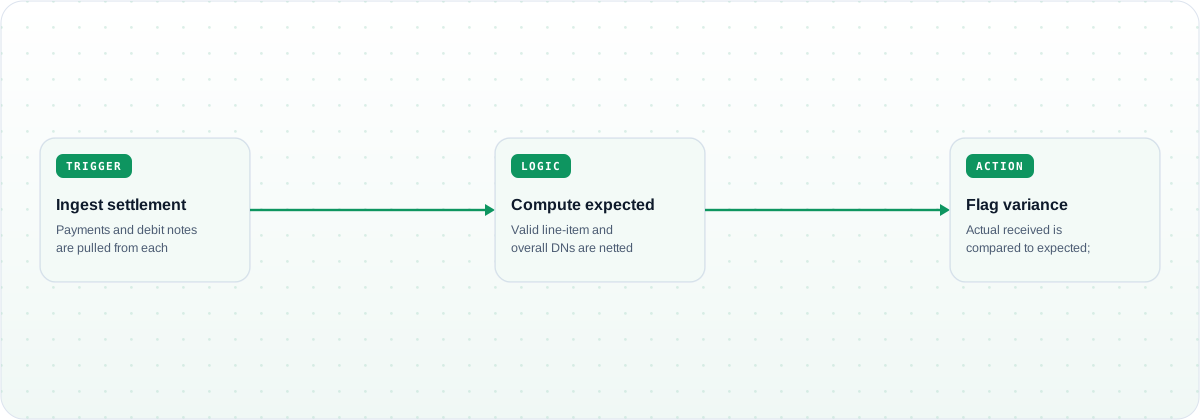
Finance stops reconstructing payments by hand. For every invoice the workflow knows what should have been paid after valid debit notes, compares it to what arrived, and surfaces every gap as a specific, chaseable line.
Invoice value minus mapped line-item and overall debit notes gives the expected figure, checked against every payment received.
Any variance from expected is flagged the moment the settlement lands, keeping claims inside the dispute window.
Splits one payment across multiple invoices and accumulates multiple payments against one invoice automatically.
Each unexplained gap carries its invoice, DN mapping and amount, so collection is a filing task, not an investigation.
Bikaji. Bikaji reached 99% reconciliation accuracy and recovered 60+ hours a week by automating PO, invoice and payment matching into SAP.
Customers run this template across Blinkit, Zepto, Swiggy Instamart, BigBasket, Amazon, Flipkart, Nykaa, Myntra, Noon, Namshi, Trendyol, Zalando, Reliance Retail, DMart and Metro, spanning India, the Middle East and Southeast Asia. Additional channels and systems can be added to the workflow on request.
Invoice value minus valid line-item debit notes (quantity, price, tax) mapped to its lines, minus valid overall debit notes (promo, RTV) allocated to it. The actual received amount is then compared to flag variances.
Every connected channel across quick commerce, ecommerce and modern trade, including Blinkit, Zepto, Swiggy Instamart, BigBasket, Amazon, Flipkart, Nykaa, Myntra, Noon, Namshi, Trendyol, Zalando, Reliance Retail, DMart and Metro.
Yes. The workflow splits a single settlement across the invoices it covers and accumulates multiple payments against one invoice, so the true received amount per invoice is always known.
See expected-versus-actual payment computed across all your marketplaces, with short payments flagged automatically.
Book a demo →A workflow template that automatically creates tickets across marketplace portals based on…
A workflow template that downloads debit note PDFs across marketplaces, reads the remarks,…
A workflow template that allocates marketplace settlements against open invoices line by l…