
Get orders, ads, settlements and inventory out of every marketplace portal and into one analysis-ready warehouse — automatically, on a schedule, with the schema already normalised.
 Zepto
 Swiggy Instamart
 Amazon
 Flipkart
 Myntra
 DMart
 Metro
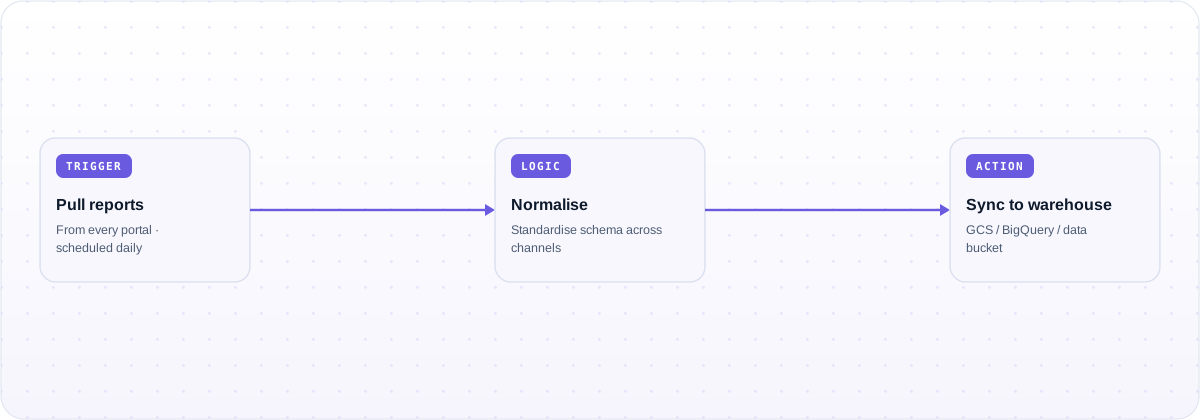
Analysts stop exporting CSVs by hand. Every portal report lands in your warehouse on schedule, already normalised, so dashboards and planning run on same-day data instead of last week's.
Orders, ads, settlements and inventory from every channel, standardised into one schema your BI tools can query directly.
Scheduled syncs replace weekly manual pulls, so a buybox loss or settlement gap is visible today, not in next week's review.
Connectors and normalisation are pre-built, so the pipeline does not need a data engineer to maintain when a portal changes a column.
Raw reports are landed immutably alongside the normalised tables, giving a full audit trail behind every number.
Opptra. Automating extraction into their warehouse gave Opptra same-day data freshness across 100k+ SKUs and returned 100+ hours a month previously lost to manual pulls.
Customers run this template across Blinkit, Zepto, Swiggy Instamart, BigBasket, Amazon, Flipkart, Nykaa, Myntra, Noon, Namshi, Trendyol, Zalando, Reliance Retail, DMart and Metro, spanning India, the Middle East and Southeast Asia. Additional channels and systems can be added to the workflow on request.
It automatically pulls reports — orders, settlements, ads, inventory — from every connected marketplace portal on a schedule, normalises them into a common schema, and writes them to GCS, BigQuery or a data-warehouse bucket, so analysis runs on fresh, standardised data without manual exports.
Google Cloud Storage, BigQuery and comparable data-warehouse buckets are supported as destinations, with normalised tables written in an analysis-ready format.
No. The connectors and the normalisation layer are pre-built and maintained centrally, so a portal changing a report format does not require you to patch your own scripts.
See the data warehousing template running against your channels and your GCS or BigQuery bucket.
Book a demo →A workflow template that ingests POs and punches sales orders or invoices across ERPs, wit…
A workflow template that automatically sends PO, SO and invoice communications to the righ…
A workflow template that identifies the cheapest logistics provider per shipment based on …